The Ground Beneath You Is Lying: How Your Feet Are Quietly Wrecking Your Whole-Body Alignment
Let's be honest — when something hurts in your lower back or your knees start nagging you on the morning commute, your feet are probably the last thing on your mind. You might stretch your hamstrings, adjust your office chair, or maybe even splurge on a new mattress. And yet, month after month, the tension keeps coming back.
Osteopathic practitioners have a different starting point. Before they look at your spine or your shoulders, many of them look down — way down. Because the way your feet make contact with the ground isn't just a foot problem. It's a whole-body story.
Your Body Is a Chain, Not a Collection of Parts
One of the foundational ideas in osteopathic medicine is that the body functions as a single, integrated unit. Nothing works in isolation. Your muscles, joints, fascia, and nerves are all in constant conversation with each other — and that conversation starts the moment your foot hits the floor.
This interconnected system is often called the kinetic chain. Think of it like a line of dominoes. When one piece shifts out of alignment, everything above it has to compensate. Your ankle adjusts. Your knee rotates slightly inward. Your hip tilts. Your lumbar spine curves to compensate for that tilt. And suddenly you're wondering why your upper back is sore when all you did was stand at a barbecue for a few hours.
That's not bad luck. That's physics — and it starts with your feet.
What Restricted Ankle Mobility Actually Does to You
Ankle mobility is one of the most overlooked contributors to postural dysfunction in the US, and it's shockingly common. Whether it's from old sports injuries, years in stiff dress shoes, or simply a sedentary lifestyle, many adults walk around with ankles that don't move the way they're designed to.
When your ankle can't dorsiflex properly — meaning it can't flex upward through its full range — your body improvises. During walking, squatting, or even just standing still, your knee will cave inward or your heel will rise slightly to compensate for what the ankle can't do. Over time, that workaround becomes a habit your nervous system reinforces automatically.
From an osteopathic perspective, this kind of compensation isn't just a mechanical problem. Restricted joints affect circulation, lymphatic flow, and even nerve signaling in the surrounding tissue. A stiff ankle isn't just tight — it's creating a kind of biological traffic jam that ripples upward through the entire system.
Fallen Arches and the Myth of "Just Get Insoles"
Flat feet — or more accurately, overpronation — are incredibly common. And the standard American response is usually to buy some arch support insoles and call it a day. For some people, that helps. But it doesn't address the underlying issue, and it certainly doesn't explain why the arches have fallen in the first place.
Your arch isn't just a structural feature. It acts as a shock absorber and a dynamic spring that loads and releases energy with every step. When that spring collapses, the entire lower limb loses a critical source of mechanical stability. The ankle rolls inward, the tibia rotates, the knee tracks poorly, and the hip has to work overtime to stabilize what the foot and ankle can no longer support.
Osteopathic manual therapy often addresses fallen arches by working not just on the foot itself, but on the soft tissue and joint mobility throughout the entire lower extremity — because the arch collapse is frequently a symptom, not the root cause. Tight calves, restricted hip flexors, or even tension patterns in the lower back can alter the way load is distributed through the foot.
Tension You Can't See: Plantar Fascia and the Fascial Web
If you've ever dealt with plantar fasciitis, you know the particular misery of that first step out of bed in the morning. What many people don't realize is that the plantar fascia — the thick band of connective tissue running along the bottom of your foot — is directly continuous with the fascial network that runs up through your calf, hamstring, and all the way into your lower back.
Osteopathic medicine has long recognized fascia as a body-wide communication system. When the plantar fascia becomes chronically tight or inflamed, that tension doesn't stay in your foot. It tugs. It shortens the posterior chain. It can contribute to hamstring tightness that no amount of stretching will fully resolve, because you're stretching the middle of a rope while ignoring the tension at both ends.
This is why treating plantar fasciitis in isolation — with stretching protocols or cortisone shots alone — often produces incomplete results. The foot is where the symptom lives, but the pattern driving it may be much higher up the chain.
Osteopathic-Informed Strategies to Reset Your Foundation
So what can you actually do about this? Here are a few approaches that align with osteopathic thinking and are accessible whether or not you have a DO in your corner right now.
Work on ankle mobility daily. Simple ankle circles and wall-assisted dorsiflexion stretches can make a meaningful difference over a few weeks. The goal is restoring the full range of motion your ankle was designed to have — not just loosening it up before a workout.
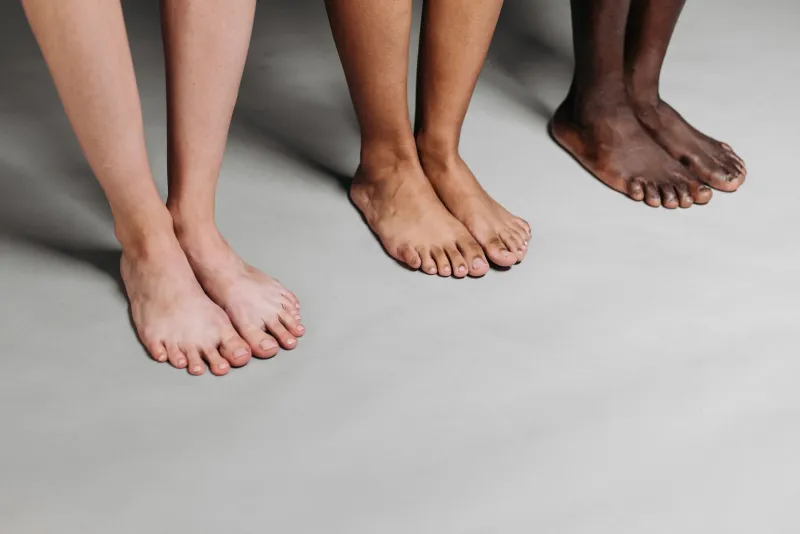
Go barefoot more often on varied surfaces. Walking on grass, sand, or even textured indoor surfaces wakes up the small intrinsic muscles of the foot that modern footwear tends to put to sleep. These muscles are critical for arch support and proprioception — your body's ability to sense where it is in space.
Roll out your feet. Using a lacrosse ball or a dedicated foot roller under each foot for a few minutes a day can reduce plantar fascia tension and improve circulation in the area. It's a small habit with surprisingly broad effects.
Consider seeing a DO or osteopathically-trained practitioner. If you've got chronic lower back pain, recurring knee issues, or hip tension that won't quit, it's worth having someone assess your foot mechanics as part of the picture. Osteopathic manipulative treatment (OMT) can address joint restrictions in the foot and ankle that self-care alone may not fully reach.
Look at your shoes. Extremely cushioned shoes can actually reduce proprioceptive feedback from the ground, making it harder for your nervous system to calibrate your movement patterns. This doesn't mean you need to go full minimalist overnight, but it's worth thinking about what your footwear is — and isn't — allowing your feet to do.
The Bigger Picture
Your feet are the only part of your body that talks to the ground every single day. They absorb impact, adapt to uneven terrain, and send constant feedback to your nervous system about where you are and how you're moving. When that foundation is compromised — even subtly — the effects travel upward in ways that can be genuinely hard to trace without looking at the whole person.
That whole-person perspective is exactly what osteopathic medicine brings to the table. And sometimes, the most powerful place to start healing isn't where the pain is. It's twenty-four inches below it.