Your Hormones Are Moving Your Skeleton — The Monthly Shift in Ligaments Nobody Told You About

Photo: Nenad Stojkovic, CC BY 2.0, via Wikimedia Commons
If you've ever noticed that your body feels completely different to work out in depending on the time of the month — looser some weeks, tighter others, more injury-prone at certain points — you're not imagining it. And you're not being dramatic.
Your hormones are actively remodeling the mechanical properties of your connective tissue throughout your cycle. Your skeleton, your ligaments, your fascia — they're all responding to chemical signals that shift week by week. And almost nobody in conventional fitness or medicine talks about this.
The Hormone-Connective Tissue Connection
Estrogen and relaxin are the two hormones most directly involved in connective tissue behavior, and both fluctuate significantly across the menstrual cycle.
Estrogen has receptors throughout your ligaments and tendons. When estrogen levels rise — particularly in the days around ovulation — it triggers changes in collagen synthesis and cross-linking that make ligaments more extensible. More flexible, yes. But also more lax. Less able to provide the crisp, passive stability that joints depend on during dynamic movement.
Relaxin, a hormone most people associate with pregnancy, is actually produced in smaller but meaningful amounts throughout the normal menstrual cycle, with a notable spike around ovulation. Its primary biological job is to soften connective tissue — a feature that's essential during childbirth but creates measurable changes in joint stability at other times too.
The result is predictable: your ligament stiffness, joint stability, and proprioceptive accuracy all shift in a monthly pattern that tracks directly with your hormonal cycle. This isn't a minor variation. Research has shown measurable differences in anterior cruciate ligament (ACL) laxity across cycle phases — which is part of why women have a significantly higher rate of ACL injuries than men, and why those injuries cluster around the ovulatory phase.
The Four Phases and What They Mean for Your Body
Thinking about your cycle in four broad phases gives you a useful framework for understanding what your structural system is doing at any given point.
Menstrual Phase (Days 1–5 approximately) Estrogen and progesterone are both low. Inflammation markers are often elevated. Energy tends to be lower, and connective tissue is neither especially lax nor especially rigid. For many women, this is a time when the body benefits from gentler movement — not because of pain, but because the nervous system is in a different regulatory state and pushing hard against it tends to backfire.
Follicular Phase (Days 6–13 approximately) Estrogen begins climbing. Energy typically increases. Tissue feels more responsive. This is often when training feels best — the body is more anabolic, recovery is faster, and coordination tends to be sharper. The structural system is stable enough to handle load without the laxity concerns of ovulation.
Ovulatory Phase (Around Day 14) Estrogen peaks. So does relaxin. This is the highest-risk window for ligament injuries, particularly at weight-bearing joints like the knee and ankle. The joints are more mobile — which can feel great — but passive stability is reduced. Neuromuscular control becomes more critical during this phase because the ligaments are doing less of the passive stabilization work. Landing mechanics, cutting movements, and high-load training all carry elevated risk if the surrounding musculature isn't picking up the slack.
Luteal Phase (Days 15–28 approximately) Progesterone rises. Tissue tends to feel tighter and less mobile. Some women experience more fascial tension and joint stiffness during this phase. Recovery can be slower. This isn't a phase to force flexibility work aggressively — the tissue is in a different state and responds differently to load.
What This Means for Posture and Structural Alignment
From an osteopathic standpoint, this monthly variation in connective tissue properties has real implications for skeletal alignment — not just athletic performance.
Ligaments are a primary source of proprioceptive input to the nervous system. They tell the brain where joints are, how they're loaded, and how to coordinate muscle activation around them. When ligament laxity increases, the quality of that proprioceptive signal changes. The nervous system has to work harder to maintain positional accuracy, and it often compensates by increasing muscle tone — which can manifest as tension, guarding, and altered movement patterns throughout the kinetic chain.
For women who already have structural asymmetries or existing fascial restrictions, these hormonal shifts can amplify existing patterns. A slightly unstable sacroiliac joint, for example, may feel fine most of the month and become genuinely symptomatic around ovulation when the surrounding ligaments lose some of their passive holding capacity.
This is something osteopathic physicians commonly see in practice — cyclical musculoskeletal complaints that track with the menstrual cycle but get labeled as mysterious or psychosomatic because the connection isn't on most practitioners' radar.
Training Smarter, Not Harder
Understanding your hormonal cycle isn't about limiting yourself. It's about working with your physiology instead of against it.
During the follicular phase, your body is primed for strength work, skill acquisition, and higher training loads. Take advantage of it.
Around ovulation, prioritize neuromuscular control. This is a great time for balance work, coordination drills, and making sure your movement patterns are clean — especially if you're doing anything with high impact or lateral cutting. Be thoughtful about pushing end-range flexibility aggressively when your joints are already at their most mobile.
During the luteal phase, honor the shift. Longer warm-ups, more emphasis on recovery, and less aggressive flexibility work tend to serve women better than pushing the same intensity as the follicular phase.
The Recovery Timing Nobody Talks About
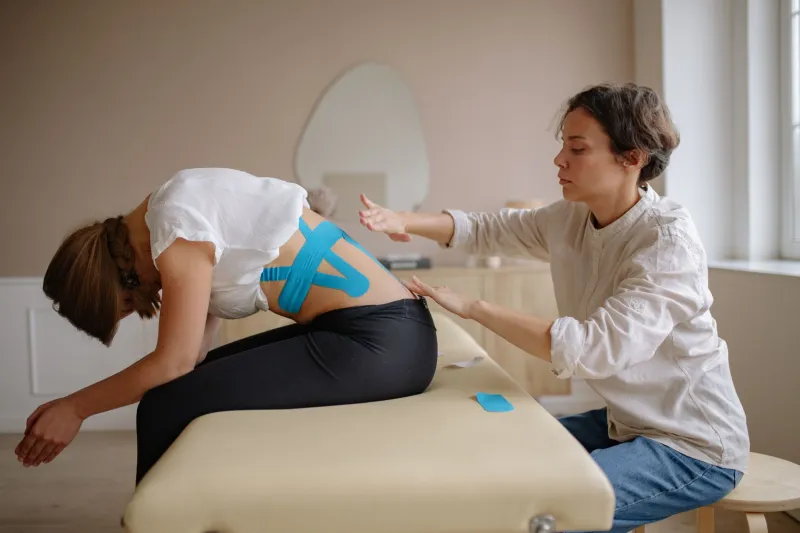
Recovery from manual therapy, including osteopathic treatment, can also vary across the cycle. Tissue that's more extensible around ovulation may respond more readily to certain types of soft tissue work. Tissue in the luteal phase may need gentler approaches to avoid creating unnecessary guarding responses.
If you work with a manual therapist or osteopathic physician, it's worth noting where you are in your cycle when you come in — and sharing that information. It can genuinely change how treatment is approached and how your body responds.
Your body isn't the same structure every day of the month. Your skeleton, your ligaments, your entire fascial system are in constant hormonal conversation. Learning to read that conversation — and respond to it intelligently — is one of the most underutilized tools in women's health, fitness, and structural wellbeing. Your cycle isn't a liability. It's a map.