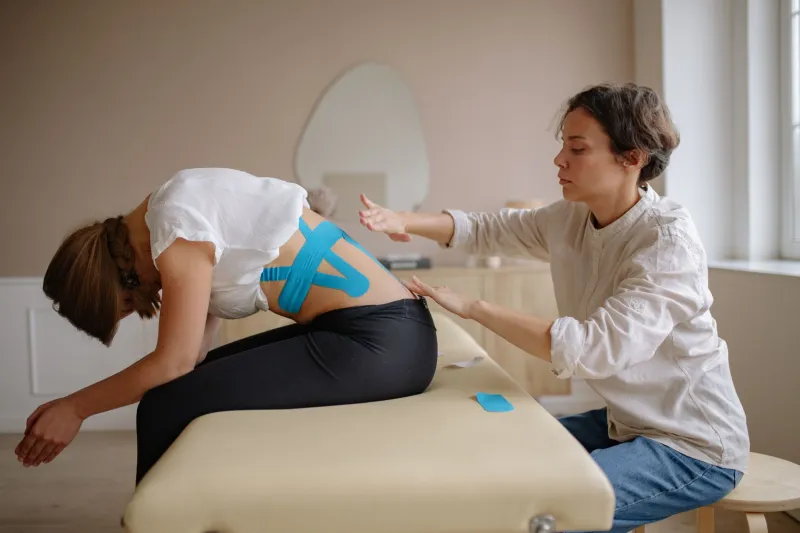
That Old Injury Is Still Running Your Body — The Hidden Life of Scar Tissue
Photo: Internet Archive Book Images, No restrictions, via Wikimedia Commons
You rolled your ankle in college. You had a C-section six years ago. You tore your rotator cuff and did the physical therapy and got the all-clear. Life moved on.
Except your body didn't fully move on with you.
There's a reason so many people walk around with nagging stiffness, mysterious tension, and movement patterns that feel slightly off — even when every scan comes back clean and every doctor says you're fine. Scar tissue is often the invisible culprit. And the way conventional medicine handles it is, frankly, incomplete.
What Scar Tissue Actually Is (And Why It's Not Just Local)
When your body repairs damaged tissue, it doesn't rebuild the original architecture. Instead, it lays down collagen fibers in a dense, somewhat chaotic pattern — like patching a road with concrete instead of matching asphalt. This scar tissue gets the job done structurally, but it's stiffer, less elastic, and poorly organized compared to the surrounding tissue it replaced.
Here's where most people's understanding stops: they think of scar tissue as a local patch. A fixed spot. Done.
But your body is wrapped in a continuous web of connective tissue called fascia — a three-dimensional matrix that connects every muscle, organ, nerve, and bone in your body. Scar tissue doesn't form in isolation from that web. It integrates into it, pulling on surrounding fascial lines, creating tension in areas that had nothing to do with the original injury.
That old knee surgery? The fascial restrictions from it can travel up into your hip, across your lower back, and even affect how your diaphragm moves when you breathe. This isn't speculation — it's basic fascial anatomy that osteopathic practitioners have been working with for decades.
Why Rehab Stops Too Soon
Standard physical therapy is genuinely good at what it's designed to do: restore enough function to get you back to daily life. Strengthen the muscles around the injury, reduce inflammation, rebuild range of motion. Check, check, check.
What it rarely addresses is what the scar tissue is doing to the broader connective tissue system — and how that reorganization affects your nervous system.
Fascia is densely packed with mechanoreceptors and proprioceptors — sensory nerve endings that constantly feed your brain information about where your body is in space and how it's moving. When scar tissue stiffens a fascial region, it distorts that sensory input. Your brain starts receiving slightly inaccurate maps of your own body. Over time, it compensates. Muscles start working harder than they should. Movement patterns shift. Load gets distributed unevenly across joints.
Years later, you develop hip pain that seems to come out of nowhere. Or chronic shoulder tension that no amount of stretching resolves. Or a recurring low back issue that flares every few months without a clear trigger.
The original injury healed. The fascial reorganization from it did not.
The Nervous System Piece Nobody Mentions
Here's something even more overlooked: scar tissue can directly compress or irritate peripheral nerves that run through fascial compartments. This isn't just about pain. Nerves carry motor signals, autonomic signals, and sensory information. When a nerve is chronically compressed by dense scar tissue, the quality of those signals degrades.
From an osteopathic perspective, this is a whole-body event. A restriction in one part of the fascial network can alter tension patterns that affect visceral function, breathing mechanics, and even the tone of your autonomic nervous system. An old abdominal scar — from surgery, injury, or even a cesarean section — can create enough fascial drag to influence how the diaphragm moves, which in turn affects vagal tone and your body's ability to shift into rest-and-digest mode.
This is why osteopathic physicians and osteopathic manual practitioners assess the entire body when someone comes in with a complaint, rather than just the symptomatic area. The complaint is rarely where the story started.
How to Know If Scar Tissue Is Driving Your Dysfunction
A few signs that old scar tissue may be running interference on your body:
- You have chronic tension that never fully releases, even with regular massage or stretching
- Your movement feels asymmetrical — one side loads differently, one hip rotates less freely
- You have a history of recurring injuries in the same region or in seemingly unrelated areas
- You notice that old scar sites feel numb, overly sensitive, or slightly sunken compared to surrounding tissue
- Your recovery from workouts feels disproportionately slow on one side of your body
None of these symptoms will show up on an MRI. That doesn't make them less real.
What Osteopathic Assessment Looks For
An osteopathic physician evaluating scar tissue isn't just pressing on the scar itself. They're tracing fascial lines, assessing motion quality through joints and soft tissue, and looking for the places where the body has compensated. The scar might be on your abdomen, but the restriction pattern it's created might be showing up most prominently in your thoracic spine or your hip flexors.
Treatment approaches vary — myofascial release, visceral manipulation, direct scar tissue mobilization, and craniosacral techniques are all tools in the osteopathic toolkit depending on the case. The goal isn't just to soften the scar. It's to restore the glide and mobility of the fascial network around it, so that the nervous system starts receiving accurate sensory information again and the body can redistribute load properly.
What You Can Do Right Now
You don't have to wait for a practitioner visit to start addressing scar tissue mobility. A few evidence-informed starting points:
Scar massage matters more than people think. Once a wound is fully closed and healed (typically 6–8 weeks post-injury or surgery), gentle scar massage — moving the tissue in multiple directions — helps prevent adhesions from anchoring to deeper layers. Most people are never told to do this.
Address the whole line, not just the spot. If you have an old ankle scar, spend time on the calf, the posterior knee, and the hip on the same side. Fascial restrictions travel.
Breathwork is surprisingly relevant. Deep diaphragmatic breathing creates internal pressure changes that gently mobilize fascial tissue throughout the trunk. If you have any abdominal scarring, this is especially important.
Find a practitioner who thinks in systems. A physical therapist trained in myofascial release or an osteopathic physician who performs manual treatment will approach old injuries very differently than a standard rehab protocol.
Your body doesn't forget an injury. But it's remarkably good at adapting — sometimes too good, compensating in ways that create new problems downstream. The scar tissue your doctor cleared years ago may still be quietly reorganizing the way you move, breathe, and feel. Understanding that is the first step toward actually finishing what the original healing process started.