What Your Shoes Are Stealing From Your Nervous System (And How to Take It Back)
The Foot Has a Secret Life Your Sneakers Are Suppressing
Your feet contain roughly 200,000 nerve endings. That's not a typo. The soles of your feet are among the most sensory-rich surfaces on your entire body — dense with mechanoreceptors that constantly sample the ground beneath you and relay that information straight to your brain and spinal cord.
This system has a name: proprioception. It's your body's internal GPS, the continuous stream of positional data that lets you walk across an uneven parking lot without falling, pivot on a basketball court without thinking, or adjust your balance mid-stride on a hiking trail. It's automatic, instantaneous, and absolutely essential.
And most Americans are walking around with it turned way down.
The culprit? The very shoes we've been told are protecting us.
How "Support" Became a Sensory Silencer
The modern athletic shoe is a marvel of engineering. Thick EVA foam midsoles, motion-control structures, gel cushioning systems, rigid shanks — all designed to absorb shock, correct pronation, and make your feet feel like they're walking on clouds.
The problem is that "feeling like clouds" is the exact opposite of what your nervous system needs.
When you load a thick, cushioned sole between your foot and the ground, you're essentially wrapping a layer of sensory insulation around one of your body's primary input devices. The mechanoreceptors in your feet are still firing, but the signal they're receiving is muffled, distorted, and incomplete. It's like trying to read a text message through three layers of oven mitts.
Your brain adapts. It has to. Over time, it learns to rely less on foot feedback and more on other inputs — your eyes, your vestibular system, your hips — to piece together a picture of where your body is in space. That compensation works, sort of. But it's inefficient, and it leaves gaps.
The Downstream Consequences Nobody Talks About
Here's where osteopathic thinking becomes really useful. The body is a unit. When one part of the sensory system goes quiet, the rest of the body reorganizes around that deficit — and those reorganizations have real consequences up the chain.
Ankle instability is one of the most direct. When your foot can't accurately read the ground, your ankle joint loses its split-second ability to micro-adjust. You roll ankles more easily. Sprains become recurring events. And because each sprain further disrupts the proprioceptive nerve fibers in the joint capsule, the instability compounds over time.
Altered gait mechanics follow close behind. People in heavily cushioned shoes tend to heel-strike harder — the padding encourages it. That changes the timing and loading patterns all the way up through the knee, hip, and lumbar spine. Osteopathic physicians frequently see patients with chronic low back pain, IT band syndrome, or knee discomfort whose movement patterns trace directly back to how their feet are — or aren't — communicating with the ground.
Intrinsic foot muscle atrophy is another issue that flies under the radar. Your foot has 19 muscles. Most of them exist to create fine-tuned, dynamic stability as you move. When a stiff, supportive shoe does that job for them, those muscles gradually weaken from disuse. The arch becomes dependent on external structure rather than its own strength. And when you eventually ask those muscles to do their job — say, on a trail run or a beach walk — they're simply not up to the task.
It's Not Just About Your Feet
The proprioceptive signal from your feet doesn't just influence your ankles. It feeds into a whole-body postural control system that runs from the ground up through your fascia, your deep spinal stabilizers, your cerebellum, and your cortex.
When that signal is chronically dampened, your body's postural reflexes become slower and less precise. Research in older adults has consistently linked reduced plantar sensation with increased fall risk — but the degradation starts well before old age. Athletes who train exclusively in maximally cushioned footwear often show measurably slower reactive balance responses compared to those with more varied footwear exposure.
From an osteopathic perspective, this isn't surprising. The foot is the foundation. When the foundation is sending noisy or incomplete data, every structure above it has to work harder to compensate — and that chronic compensatory effort shows up as tension, fatigue, and dysfunction in places that seem completely unrelated to your feet.
The Minimalist Shoe Movement: Promise and Pitfalls
The barefoot and minimalist footwear movement has been gaining traction for a couple of decades now, sparked in part by books like Born to Run and a wave of research questioning the assumptions behind modern shoe design. Brands like Vivobarefoot, Xero Shoes, and Merrell's minimalist lines have built real followings among people looking to reconnect with more natural foot mechanics.
The evidence supporting less shoe is genuinely interesting. Studies have shown that minimalist footwear can improve foot muscle strength, enhance proprioceptive acuity, and shift gait patterns toward more midfoot and forefoot striking — all things that look good on paper.
But here's the honest caveat: transitioning too fast is a very real way to hurt yourself.
If your feet have spent 20 or 30 years in conventional shoes, your intrinsic muscles are deconditioned, your Achilles tendon and plantar fascia are adapted to heel elevation, and your movement patterns have organized around the support you've been wearing. Strapping on a zero-drop minimalist shoe and going for a three-mile run is roughly equivalent to starting a heavy deadlift program without any training history. The injury potential is high.
A Smarter Way to Rebuild Foot Intelligence
The goal isn't to throw your shoes away tomorrow. It's to gradually reintroduce sensory input and rebuild the capacity your feet were born with.
A few practical starting points:
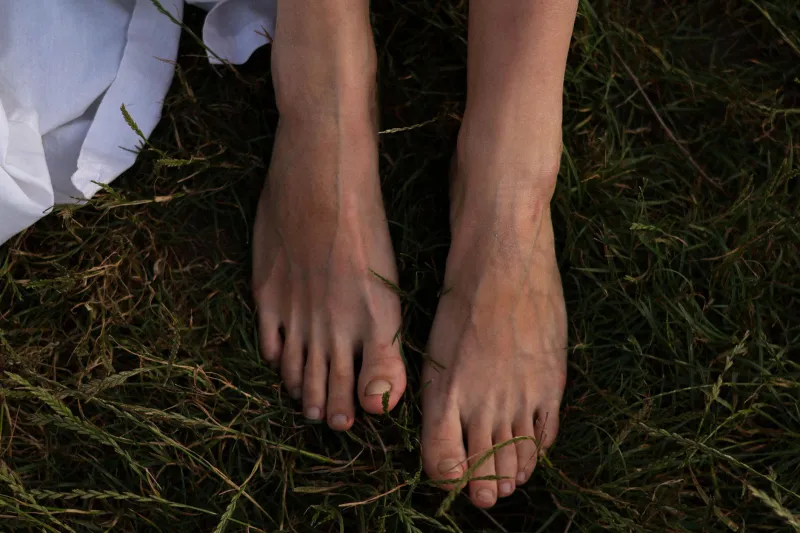
Spend more time barefoot at home. This sounds almost too simple, but it's genuinely effective. Walking barefoot on varied surfaces — carpet, hardwood, grass, gravel if you're feeling adventurous — reactivates dormant mechanoreceptors and begins rebuilding the neural pathways your feet use to read the ground.
Add foot-specific strengthening work. Towel scrunches, single-leg balance drills, short-foot exercises (where you actively shorten the foot by drawing the ball of the foot toward the heel without curling the toes) — these target the intrinsic muscles that supportive shoes have been standing in for.
Transition footwear gradually. If minimalist shoes interest you, introduce them for short, low-intensity activities first. Walk in them before you run. Give your tissues months, not weeks, to adapt.
Work with a practitioner who understands movement. An osteopathic physician or a physical therapist with a background in functional movement can assess your foot mechanics, identify compensatory patterns, and help you transition in a way that's actually safe for your specific body.
Your Feet Are Trying to Talk to Your Brain
Proprioception isn't a niche concept for biomechanics nerds. It's a fundamental part of how your nervous system keeps you upright, coordinated, and connected to the world beneath you. Every step is a conversation between your feet and your brain — and for most Americans, that conversation is being filtered through an inch of foam.
You don't have to go full barefoot minimalist to make a difference. But paying attention to what your footwear is doing to your sensory system — and taking small, deliberate steps to restore that feedback — is one of the more meaningful things you can do for your long-term movement health.
Your feet know more than you think. It might be time to start listening to them.